
What Happens to Your Body Fat After Liposuction Surgery?
Table of Contents
At some point, almost every patient reaches this exact thought:
“I’m not overweight… so why does this fat refuse to go?”
It’s usually one area.
Lower abdomen. Love handles. Thighs.
You’ve already done what people recommend:
- Diet control
- Consistent Workouts
- Weight reasonably stable
And still, that stubborn fat doesn’t move.
That’s when Liposuction Surgery comes into the picture.
But before you even consider it, your mind goes here:
“Agar fat nikal diya… toh body kaise react karegi?”
“Kya yeh permanent solution hai ya temporary fix?”
“Will I look natural… or obviously ‘done’?”
These are not small doubts.
They’re exactly what you should be thinking.
Because liposuction is not about weight loss.
It’s a body contouring procedure that changes how your body is shaped, not just how much you weigh.
And unless you understand what actually happens to your fat after the procedure, you’ll either:
- Expect too much
- Or hesitate for the wrong reasons
So let’s get clear on one thing first:
What exactly happens to your body fat after Liposuction Surgery, and what stays with you long-term?
Understanding How Body Fat Is Stored
Before you understand liposuction, you need to understand one basic thing:
Your body doesn’t store fat everywhere equally.
It follows a pattern. And that pattern is mostly genetic.
That’s why:
- Some people gain fat in the abdomen
- Some in thighs
- Some in arms or chin
Now here’s the important part.
Your body has fat cells in these areas. When you gain weight:
- These cells don’t increase much in number
- They expand in size
So when you diet or exercise, you’re shrinking these cells, not removing them.
That’s why the fat reduces… but never fully disappears from stubborn areas.
How Liposuction Surgery Removes Fat Cells
This is where Liposuction Surgery works differently.
It doesn’t try to shrink fat.
It removes fat cells from the targeted area.
What your surgeon does:
- Identifies stubborn fat pockets
- Breaks down fat cells
- Removes them using controlled suction
Once these fat cells are removed, they are gone from that area.
Read that again.
They don’t “reduce.”
They don’t “sleep.”
They are physically removed.
That’s why this is called a body contouring procedure, not a weight-loss method.
The goal is shape, not just numbers on a weighing scale.
Related: Beyond Diet and Exercise: Why Liposuction Surgery is Your Body’s Reset Button
How the Body Adjusts After Fat Removal
This is where most people get impatient.
Immediately after surgery, your body won’t look “final.”
Why?
Because:
- There is swelling
- Tissues are adjusting
- Skin is adapting to the new contour
What you’ll typically notice:
- First few weeks: swelling, mild tightness
- 3–4 weeks: visible improvement
- 2–3 months: more refined shape
- Up to 6 months: final contour settles
So if you’re checking the mirror daily and judging results, you’ll misjudge it.
Your body needs time to settle into the new structure.
Long-Term Body Contouring Benefits
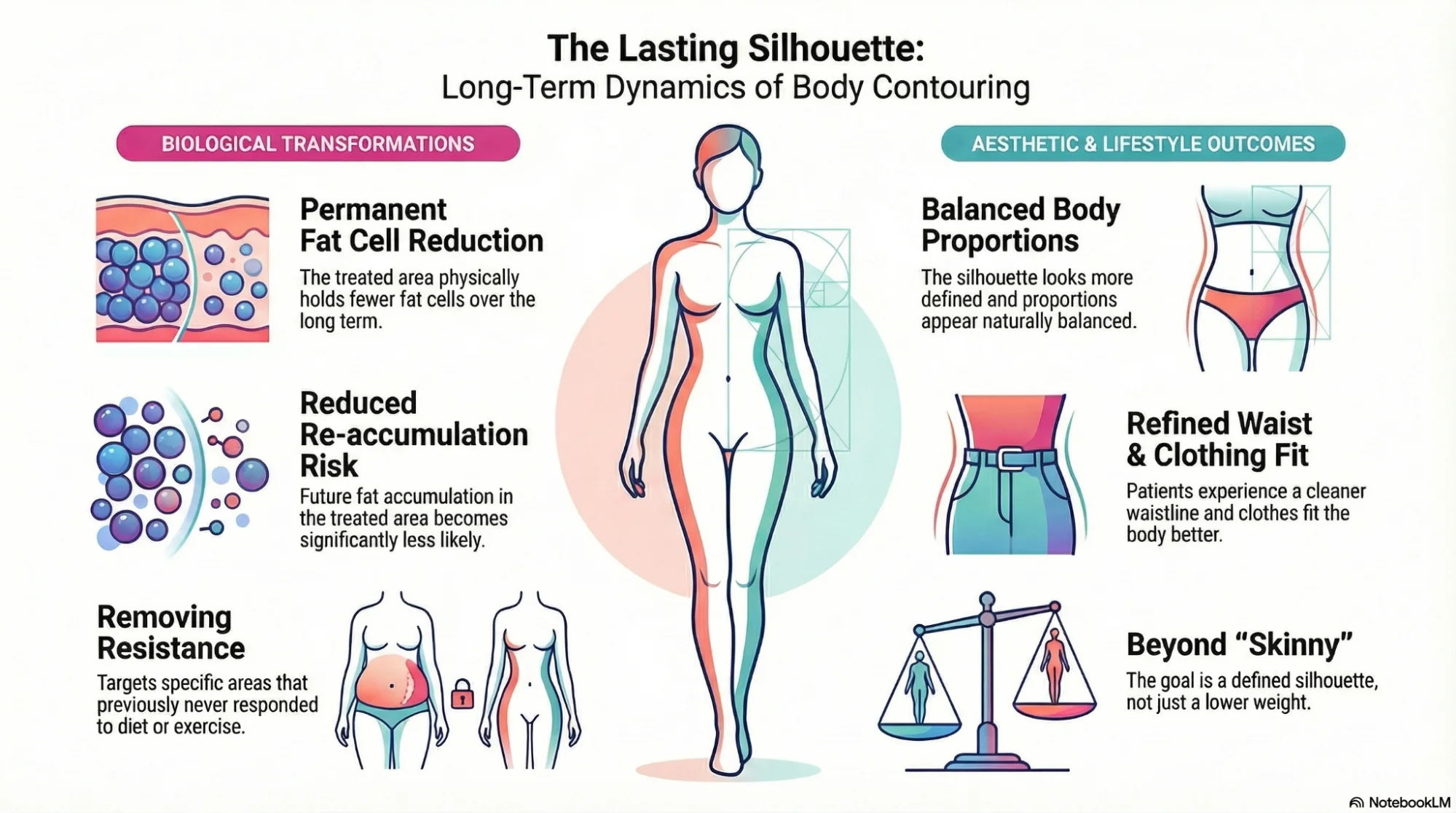
Now let’s talk about what actually changes over the long term.
After Liposuction Surgery:
- The treated area holds fewer fat cells
- Fat accumulation in that area becomes less likely
- Body proportions start looking more balanced
This is where patients notice real value:
- Waist looks cleaner
- Clothes fit better
- Silhouette looks more defined
It’s not about becoming “skinny.”
It’s about removing resistance from areas that never responded.
Related: Post-Weight Loss Surgeries: How to Address Loose Skin and Regain Confidence
The Role of Lifestyle in Maintaining Results
Here’s the part many clinics avoid saying clearly.
Liposuction is powerful, but it’s not magic.
Removed fat cells don’t come back, but remaining fat cells can still grow if weight increases
So what happens if lifestyle goes off track?
- Fat may accumulate in untreated areas.
- Or mildly in treated areas (but usually less than before)
You don’t need extreme discipline.
You need:
- Stable weight
- Basic activity
- Sensible eating
Think of liposuction as a reset.
Not a replacement for habits.
Why Surgical Planning Matters
This is where outcomes are actually decided. Anyone can remove fat. Not everyone can shape a body well.
Good liposuction depends on:
- How much fat to remove
- Where to remove from
- How skin will respond
- Maintaining natural proportions
Over-removal = unnatural dips
Under-removal = no visible change
An experienced surgeon like Dr. Ashish Ghuge focuses on:
- Controlled fat removal
- Symmetry and balance
- Natural-looking contours
The best results are the ones people notice… but can’t point out.
FAQs About Liposuction Surgery
If your issue is stubborn fat that doesn’t respond to diet or exercise, then yes, it’s worth considering. Recovery is usually manageable, with most patients returning to routine activities within a few days.
You’ll see initial changes in a few weeks, but final results typically take 3 to 6 months as swelling completely subsides.
There’s no fixed age. What matters is stable weight, good skin elasticity, and realistic expectations.
No. Liposuction is not designed for major weight loss. It works best for people close to their ideal weight who want better contour.
Maintain a stable lifestyle:
- Balanced diet
- Regular physical activity
- Avoid sudden weight gain
Removed fat cells do not come back. But remaining fat cells can expand if you gain weight. So results depend partly on your habits.
Final thought
If you’re expecting Liposuction Surgery to change your body overnight, that’s the wrong expectation.
But if you’re dealing with stubborn fat that hasn’t responded to anything else, and you want a more defined, proportionate shape, this body contouring procedure can deliver exactly that.
The key is simple:
- Understand what it does
- Choose the right surgeon
- Maintain realistic expectations
Everything else follows.