
Eyelid Surgery (Blepharoplasty): When Is It Worth Considering and When Is It Not?
Table of Contents
Let me tell you how most eyelid surgery conversations actually start in my clinic.
It’s rarely someone walking in saying, “I want blepharoplasty.”
Instead, it’s more like: “Doctor, I don’t know if this is silly, but my eyes always look tired now, even when I’ve slept well. Photos mein especially… I just look exhausted. Is this fixable, or am I overthinking?”
And that right there, that hesitation is exactly the right way to start this conversation.
The Real Trigger (It's Usually Smaller Than You Think)
Most people notice it gradually. Maybe you’re putting on kajal and the skin folds differently. Or someone at a family function asks, “Sab theek hai na? You look tired.” And you think, But I’m not tired.
Sometimes it’s a selfie that doesn’t feel like you anymore. Sometimes your upper eyelid feels heavy by evening, almost like there’s extra weight there.
These aren’t dramatic moments. They’re quiet observations that add up.
The question that brings people to my clinic isn’t really “Can this be fixed?”
It’s actually: “Will fixing this make me look like myself, or will I look obviously ‘done’?”
And honestly? That fear is completely valid.
What Nobody Tells You About Eyelid Surgery
Here’s something most cosmetic websites won’t say upfront: the biggest regret in eyelid surgery isn’t complications, it’s overcorrection.
When too much skin or fat is removed, you can end up looking hollow. Or tight. Or just… different in a way that feels wrong. Not medically dangerous, but psychologically unsettling.
This illustration demonstrates why conservative planning matters in eyelid surgery.
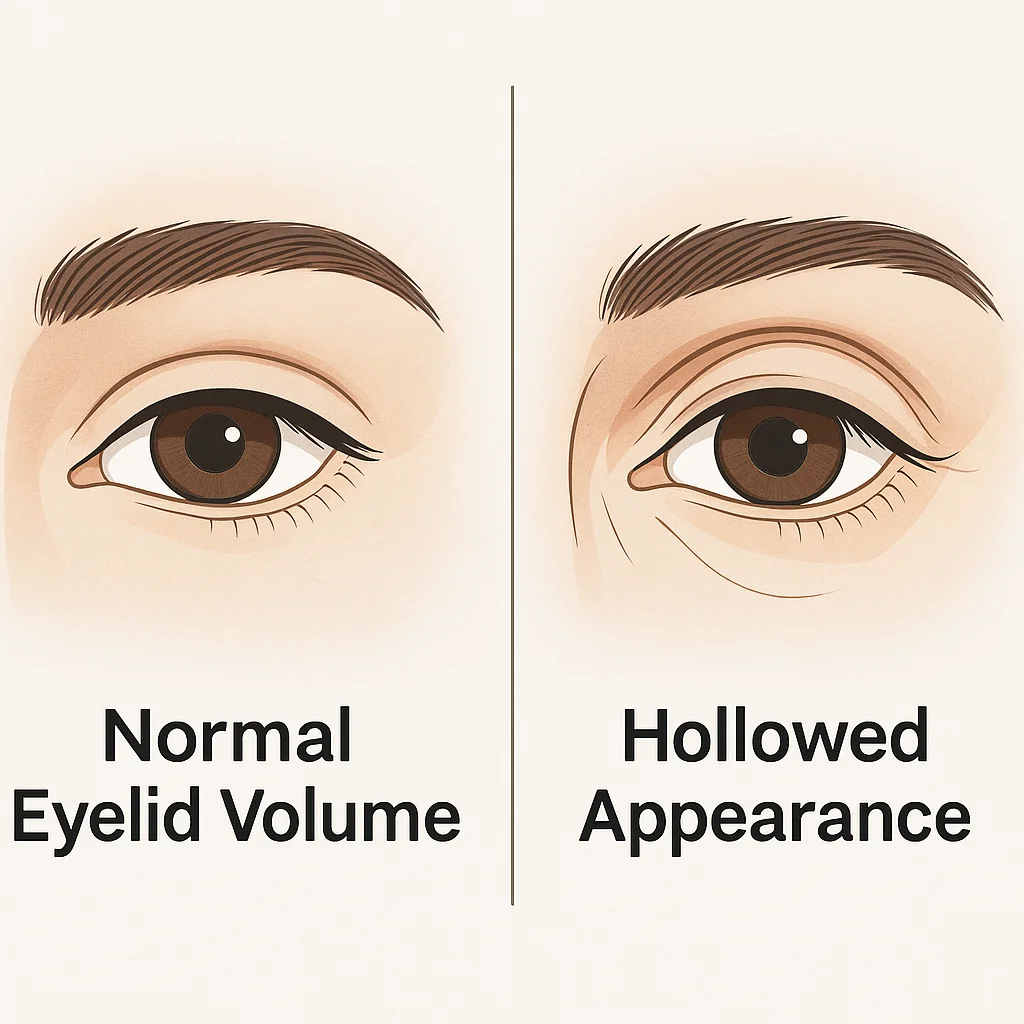
Our face is our identity. Even a millimeter-level change around the eyes affects how people recognise you, and how you recognise yourself. You should not feel like a stranger when you look at the mirror.
That’s why in my practice, I’m often more conservative than patients expect. Because in eyelid surgery, the real skill isn’t in removing more, it’s in knowing what to leave behind.
Yeh procedure itna delicate hai ki we’re working in millimeters, not centimeters.
Too much = hollow look.
Too little = no change.
The sweet spot? That comes from judgment, not aggression.
"Doctor, But Will I Still Look Like Me?"
This is the question beneath every consultation, even when patients don’t say it directly.
They’re not asking for a transformation. They’re asking for familiarity.
The ideal outcome? When your family says, “You look well-rested”, but can’t pinpoint what changed. When colleagues notice you look fresher but don’t ask, “Did you do something?”
Bas itna – rested, not reconstructed.
If someone immediately spots that you’ve had surgery, something in the planning went wrong.
Here’s where most people get stuck
You assume:
“I’m overweight, so it must be fat.”
Not always.
A lot of men sitting in front of me have both.
Some fat. Some gland.
They lose weight. The chest improves a bit.
But that central fullness never goes.
That’s the gland.
The Recovery Truth (Because Sugarcoating Helps Nobody)
Okay, let me be straight with you about recovery, because this is where a lot of clinics… let’s just say they’re optimistic.
Week 1: You’ll have swelling and some bruising. Honestly, you’ll look worse than before the surgery. I know that sounds scary, but it’s temporary and expected. This is not the time to panic and send me worried messages at midnight.
Week 2-3: Swelling reduces, but you still won’t look “normal” to yourself. This phase is psychologically tough because you’re in that in-between zone. Neither fully healed nor visibly swollen. Just… waiting.
Month 2-3: This is when things settle. The eyes find their final shape. You stop analysing every angle in the mirror and just see your face again.
Patients tell me later: “Doctor, nobody warned me about that second week feeling.”
I’m warning you now. The discomfort isn’t really physical pain; it’s timeline anxiety—the gap between what you expected and what you’re seeing.
Social recovery (jab aap comfortable feel karenge bahar jaane mein) takes longer than biological recovery (jab medically you’re fine). Plan for that.
"But Doctor, What About Laser Surgery? Isn't That Better?"
Almost every other patient asks me this now. “Doctor, laser se hota hai kya? Is it scarless? Advanced hai na?”
Let me clear this up: laser vs traditional blade, that’s not the decision that determines how you’ll look.
Laser, radiofrequency, and scalpel these affect how tissue is cut. They might reduce bleeding slightly, maybe heal marginally faster. But your final result? That depends entirely on surgical judgment: how much I remove, where I place the incisions, how I preserve your natural contours.
Technology can refine execution. It cannot fix poor planning.
And about “scarless”, there’s no such thing, really. The scars in eyelid surgery are hidden in your natural crease (upper lid) or just below the lash line (lower lid). When placed correctly, they become nearly invisible. That’s a placement strategy, not a technology miracle.
If any clinic is selling you more on their machines than their decision-making process, that’s a red flag.
The Asymmetry Reality Check
Here’s something else nobody mentions: your eyes are not identical. They never were.
One eyelid sits slightly higher. One crease is deeper. That’s normal human anatomy.
Surgery improves balance and proportion, but it doesn’t create mathematical symmetry. Expecting perfectly matching eyes is setting yourself up for disappointment.
As I tell patients, “The goal isn’t identical eyes. It’s harmonious eyes that suit your face.”
Who Should Actually Consider This (And Who Should Wait)
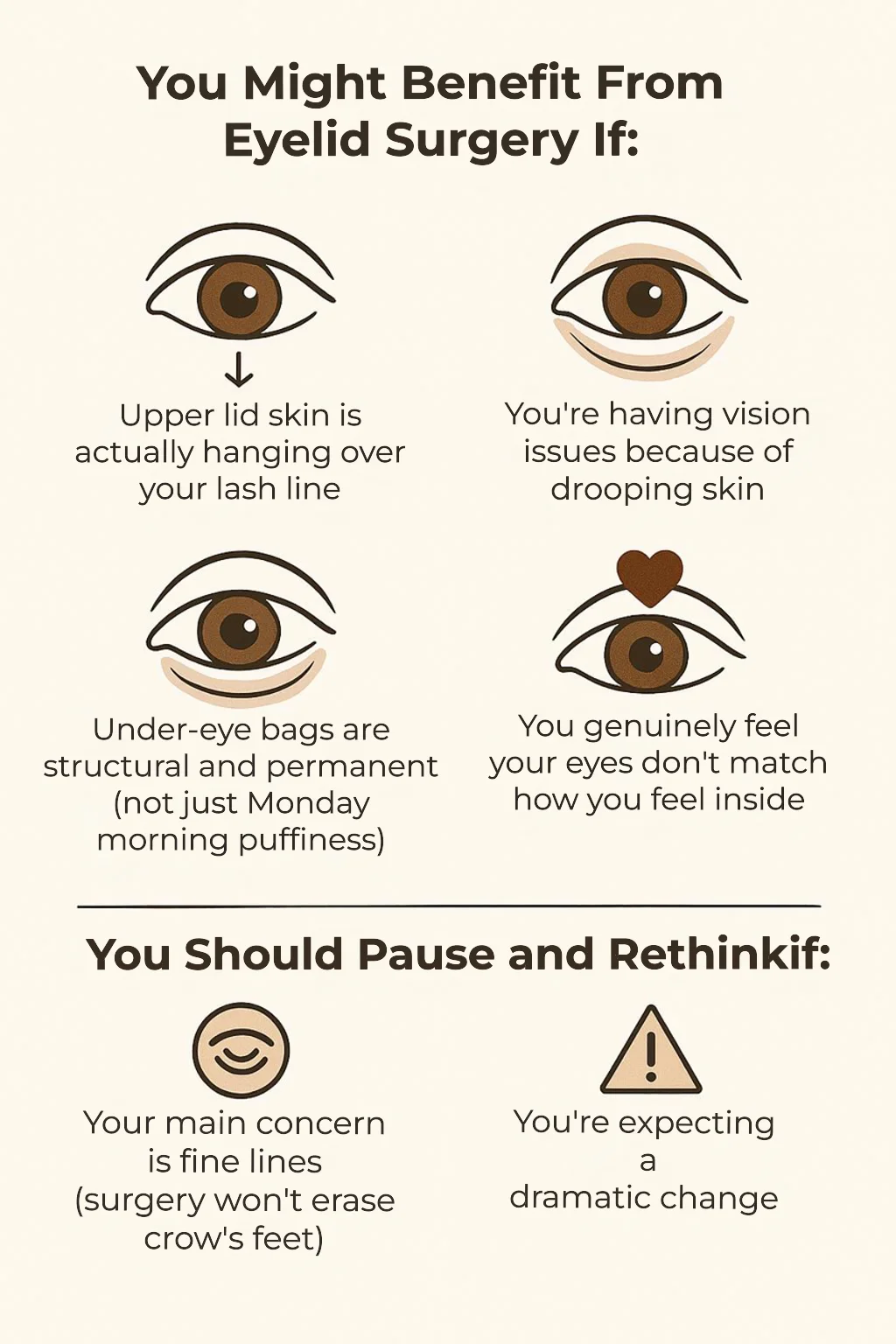
You might benefit from eyelid surgery if:
- Upper lid skin is actually hanging over your lash line
- You’re having vision issues because of drooping skin
- Under-eye bags are structural and permanent (not just Monday morning puffiness)
- You genuinely feel your eyes don’t match how you feel inside
You should pause and rethink if:
- Your main concern is fine lines (surgery won’t erase crow’s feet)
- Puffiness comes and goes with sleep or stress (that’s not surgical)
- You’re expecting perfection or a dramatic change
- You feel rushed or pressured into deciding
Sometimes the right answer isn’t surgery. Sometimes it’s waiting. Sometimes it’s trying non-surgical options first.
A responsible consultation should tell you when not to operate, not just when to book.
Related: Blepharoplasty: Achieving a Youthful Look Through Eyelid Surgery
What Eyelid Surgery Can and Cannot Do
What it CAN improve:
- Excess, drooping skin
- Persistent under-eye bags
- Heavy, tired appearance
- Vision obstruction (in some cases)
What it CANNOT guarantee:
- Perfect symmetry
- Wrinkle erasure
- Stopping future ageing
- A completely different eye shape
Managing expectations isn’t about lowering your hopes; it’s about preventing regret.
The Family Filter (And Why It Matters)
Most patients come to me on their own. But when they go home, there’s usually a spouse or family member asking: “Is this really necessary? Isn’t this just vanity? What if something goes wrong?”
That questioning? It’s actually healthy.
If a decision only makes sense inside a clinic but falls apart under family scrutiny at home, maybe it’s premature.
A good surgical decision should hold up when someone who loves you asks, “Why now? Why this?”
How I Actually Approach These Decisions
Every patient arrives with a different concern, a different face, and different expectations. Because of that, I don’t believe in a one-size-fits-all approach to eyelid surgery.
My role is not just to operate, it’s to help you choose the right degree of intervention, at the right time, for the right reasons.
In some cases, surgery offers clear benefit and lasting improvement.
In others, the most responsible approach is to proceed conservatively, allowing smaller changes to deliver more natural results.
And sometimes, the best care I can provide is recommending observation, non‑surgical management, or simply allowing more time before making a permanent decision.
This isn’t about being cautious for the sake of caution; it’s about protecting facial balance, eye comfort, and long‑term satisfaction.
Experience has taught me that patients are most satisfied when surgery is thoughtfully planned rather than hurried. Conservative planning gives us room to adapt, preserves natural expression, and reduces the risk of outcomes that feel “overdone.”
In eyelid surgery, especially, restraint is not a limitation; it’s a strategy.
And careful decision‑making is as important as technical execution.
Related: Eyes of Expertise: Exploring the Artistry of Eyelid Surgery for Youthful Eyes
The Better Question to Ask Yourself
Instead of: “Is eyelid surgery safe/effective/worth it?”
Ask this: “What version of this decision fits MY face, MY expectations, and MY tolerance for change?”
When you answer that honestly, sometimes with family input, sometimes after sleeping on it for weeks, the right path usually becomes clear.
And if that path is “not now” or “not for me,” that’s a perfectly good answer.
Add this FAQ section toward the end of your blog, just before the closing reflection. Keep the conversational, doctor-to-patient tone intact.
Frequently Asked Questions
Not in the way people usually imagine “major surgery.” It’s a delicate procedure, yes, but it’s typically done under local anaesthesia with sedation or short general anaesthesia. You’re not in the hospital for days.
What is major is the impact. We’re working on your face, your identity. So while the surgery itself is controlled and routine, the planning needs to be taken seriously.
Most people think it’s 1–2 weeks. That’s not accurate.
Swelling and bruising settle in 10–14 days, but the final look takes about 2–3 months.
That “in-between phase” is where most anxiety comes from. You’re not swollen, but you’re not fully settled either. If you know this upfront, you handle it much better.
Yes, and this is not just in your head.
When upper eyelid skin becomes heavy, your forehead muscles constantly try to compensate by lifting your brows. That effort builds up over the day.
By evening, it genuinely feels like fatigue, not just a cosmetic concern.
Short answer: Your body is healing.
Even though it’s a small-area surgery, healing still demands energy. There’s also disturbed sleep, mild discomfort, and the mental stress of “Is this healing normally?”
The good part? This phase passes. Once healing stabilises, most patients feel lighter, not heavier.
There is no “perfect age.”
It’s about anatomy, not age.
Some people need it in their 30s due to genetics. Others never need it even in their 50s.
If the concern is structural and persistent, age becomes secondary.