
Fibroadenoma Treatment: What Should You Do After Finding a Breast Lump?
Table of Contents
You felt something unusual in your breast.
A small lump. Maybe by chance.
Your first thought was simple:
“Is this cancer?”
You got it checked. Maybe an ultrasound was done.
And then you were told:
“It’s not cancer. It looks like a fibroadenoma.”
That should feel reassuring.
But it usually doesn’t.
Because now a different set of questions begins.
If it’s not cancer, why is it still there?
Should you just leave it alone?
Or do you need treatment?
And the one question almost everyone has:
“Can this turn into cancer later?”
Let’s break this down clearly.
First, understand this clearly.
A fibroadenoma is not cancer.
In most cases, it does not turn into cancer.
But that does not mean you should ignore it.
What matters is not just the name.
What matters is how that lump behaves over time.
Why are some people told to “just observe”
If your lump is:
- Smooth and moves under your fingers
- Not increasing in size
- Matching clearly on ultrasound
- Confirmed as non-cancerous
Then the safest approach is often:
No immediate treatment. Just observation.
No surgery. No urgency.
But don’t misunderstand this.
Observation does not mean forgetting about it.
It means tracking it properly.
What actually decides your treatment
Fibroadenoma treatment is not one fixed rule.
It depends on a few practical things:
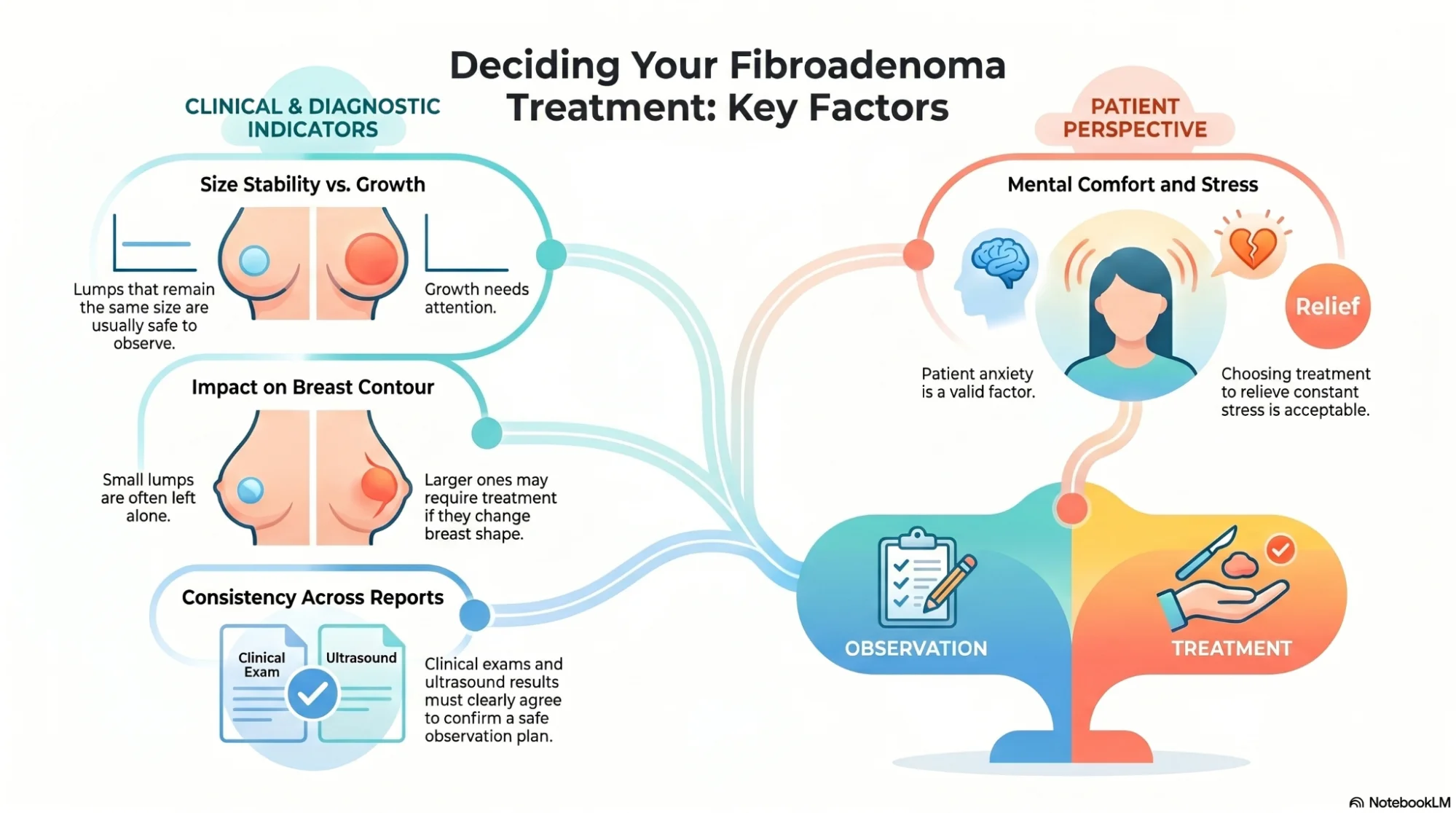
1. Has the lump changed in size?
- Same size for months → usually safe to observe
- Growing → needs attention
2. Is it affecting the shape of your breast?
- Small lumps may not matter
- Larger ones can change contour.
3. Are reports clearly matching?
- Clinical exam and ultrasound should agree.
- If not, don’t ignore it
4. How comfortable are you mentally?
- Some patients are okay observing
- Some feel constant stress knowing it’s there
Both are valid.
Also Read: Choosing Between Breast Augmentation and Breast Lift: Which Procedure is Best for Your Goals?
The biggest confusion: ignore or remove?
This is where most people feel stuck.
Family often says:
“Just remove it to be safe.”
But here’s the truth:
Removing every fibroadenoma is not necessary.
And
Ignoring every lump is also not safe.
The right decision sits in between.
When you should consider removing a fibroadenoma
Removal, or breast lump treatment, may be needed if:
- The lump is growing quickly
- Size is becoming noticeable or uncomfortable
- There is any doubt in the diagnosis
- You have multiple lumps increasing over time
- You are not mentally at ease
In these cases, breast tumour removal becomes a reasonable option.
But it should be a planned decision, not a rushed one.
If you do need surgery, who should you choose?
Not every fibroadenoma needs removal.
But when it does, how it is removed matters just as much as the removal itself.
The goal is not just to take out the lump.
The goal is to:
- Keep the breast shape natural
- Minimise visible scarring
- Avoid contour deformity
This is where a plastic surgeon’s approach becomes important.
Why a plastic surgeon's approach matters in fibroadenoma removal
A standard surgical approach focuses on removing the lump.
A plastic surgery approach goes further:
- Incisions are placed where they are less visible
- Breast shape is preserved as much as possible
- Tissue is handled carefully to avoid dents or unevenness
In simple terms:
It’s not just about removing the lump.
It’s about how your body looks after it heals.
Also Read: Finding the Best Plastic Surgeon in Mumbai: What to Look for Before You Decide
How I approach fibroadenoma removal
When surgery is needed, the focus is not just on removal.
It is planning.
- Incision placement is decided based on visibility
- Breast contour is preserved as much as possible
- Long-term appearance is considered from the start
This becomes especially important in:
- Younger patients
- Visible areas of the breast
- Larger fibroadenomas
Let’s talk honestly about surgery.
Many people are told:
“It’s a small procedure.”
“It will heal quickly.”
That’s true. But not the full picture.
You should also know:
- Even a small surgery can leave a scar
- The position of the lump affects the final look
- A slight change in shape is possible
- New fibroadenomas can still develop later
So surgery is not a “final solution.”
It solves that lump, not the tendency.
What happens if you don’t remove it?
In many cases:
- The lump stays the same
- Or grows very slowly
- Sometimes even reduces in size
But this only works if you follow a clear monitoring plan.
Not vague advice like:
“Come back if it grows.”
A proper plan includes:
- Regular check-ups
- Repeat imaging when needed
- Clear signs for when to act
Signs you should not ignore
Even if you were told it’s not cancer, watch for these changes:
- Rapid increase in size
- A lump is becoming hard or fixed
- Skin pulling or dimpling
- Nipple discharge
If you notice any of these, get it checked again.
The part no one talks about
Most decisions are not made by you alone.
Family often says:
“Remove it to be safe.”
They mean well. But your concerns are different.
You are thinking:
- “Will this leave a scar?”
- “Will my breast shape change?”
These are valid concerns.
They should be part of the decision.
Also Read: Understanding Breast Implant Revision Surgery: When and Why It’s Needed
My approach to fibroadenoma treatment
Simple and practical:
- Confirm it is truly non-cancerous
- Ensure reports match clearly
- Observe if stable
- Act only when needed
- Plan surgery carefully if required
No rushing. No ignoring.
Final clarity
A fibroadenoma is common.
And in most cases, not dangerous.
But your decision should still be thoughtful.
You don’t need panic.
And you don’t need blind reassurance.
You need:
- Clear understanding
- Proper follow-up
- And the right timing for action
That’s what good care actually looks like.
Add this FAQ section after your “Final clarity” section. Keep the tone grounded, practical, and slightly reassuring but not dismissive.
Questions Patients Still Ask
Not always.
If the lump is stable, clearly non-cancerous, and not bothering you physically or mentally, observation is often enough.
Treatment becomes necessary only when something changes, size, symptoms, or clarity in diagnosis.
You cannot rely on feel alone.
Yes, fibroadenomas are usually smooth and mobile. Cancer lumps are often harder and fixed.
But this is not a rule you should trust blindly.
Ultrasound, and sometimes biopsy, is what gives real clarity.
If reports are consistent, you can be reassured. If not, don’t ignore it.
Yes, in many cases.
But “leave it” does not mean forget it exists.
It means structured follow-up.
If you are not tracking it, you are not observing it, you are ignoring it. And that’s where mistakes happen.
There is no single clear cause.
Hormonal influence, especially estrogen, plays a role. That’s why it’s more common in younger women.
But this is not something you caused or could have prevented.
Most patients describe it as:
A smooth, firm lump
Moves slightly under the fingers
Usually painless
But don’t try to self-diagnose based on feel. Many patients assume wrong in both directions, either unnecessary panic or false reassurance.