
Pseudogynecomastia vs Gynecomastia: What’s Actually Causing Your Chest?
Table of Contents
Let me ask you something first.
Have you tried fixing your chest already?
Gym. Diet. Maybe even lost some weight.
But the chest still looks… off.
You may have Googled “is it pseudogynecomastia or gynecomastia/man boobs?”
That’s usually when you land here, trying to figure out:
Is this fat, or something else?
Fair question. And the answer changes everything.
Let’s figure it out together.
I’ll walk you through each step.
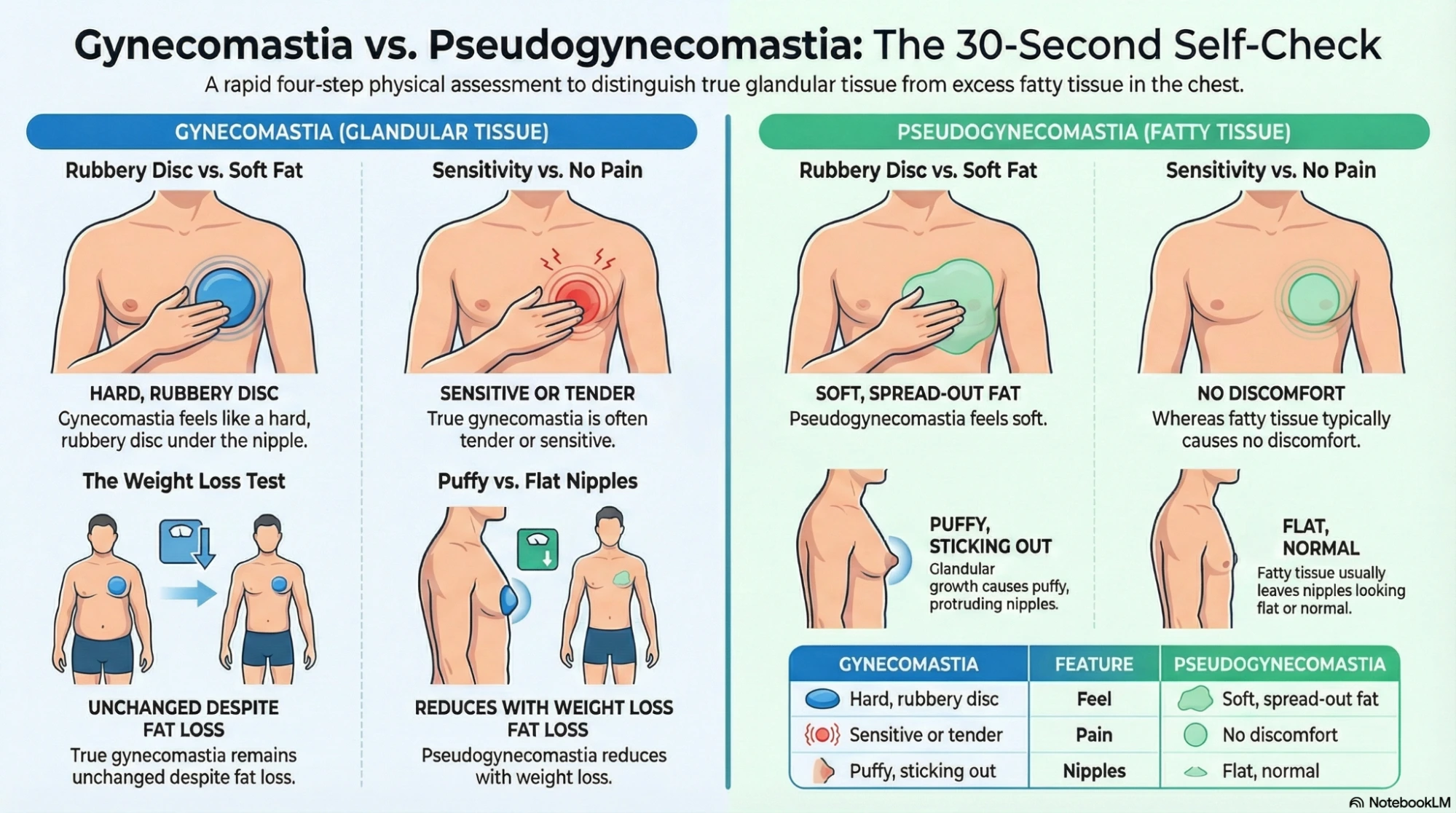
First, feel it
Place your fingers around the nipple and press gently.
What do you feel?
- If there’s a firm, rubbery disc right under the nipple, that’s gland tissue. That’s gynecomastia.
- If it just feels soft, like the fat on your stomach, that’s pseudogynecomastia.
Most people can tell the difference once they actually check properly.
Now, try this
Stand in front of a mirror and flex your chest.
- Does the area tighten and look better? → more likely fat
- Does that bulge still sit there, unchanged? → likely gland
This small test tells you more than hours of Googling.
Any discomfort?
Be honest here.
- Slight pain or sensitivity when you press it? → points toward gynecomastia
- No sensation at all? → usually fat
What about your nipples?
This is something patients notice but don’t always say.
- Are they puffy or sticking out, especially in t-shirts? → gland
- Do they look normal, just surrounded by fat? → pseudogynecomastia
| Feature | True Gynecomastia | Pseudogynecomastia |
|---|---|---|
| Primary Component | Glandular breast tissue | Adipose (fat) tissue |
| Texture | Firm, rubbery, "button-like" | Soft, squishy |
| Pain | Often tender or sensitive | Almost universally painless |
| Nipple Appearance | May look "puffy" or protrude | Usually lies flat or looks normal |
| Response to Exercise | Glandular tissue will not shrink | Often improves with weight loss |
Let me simplify it for you.
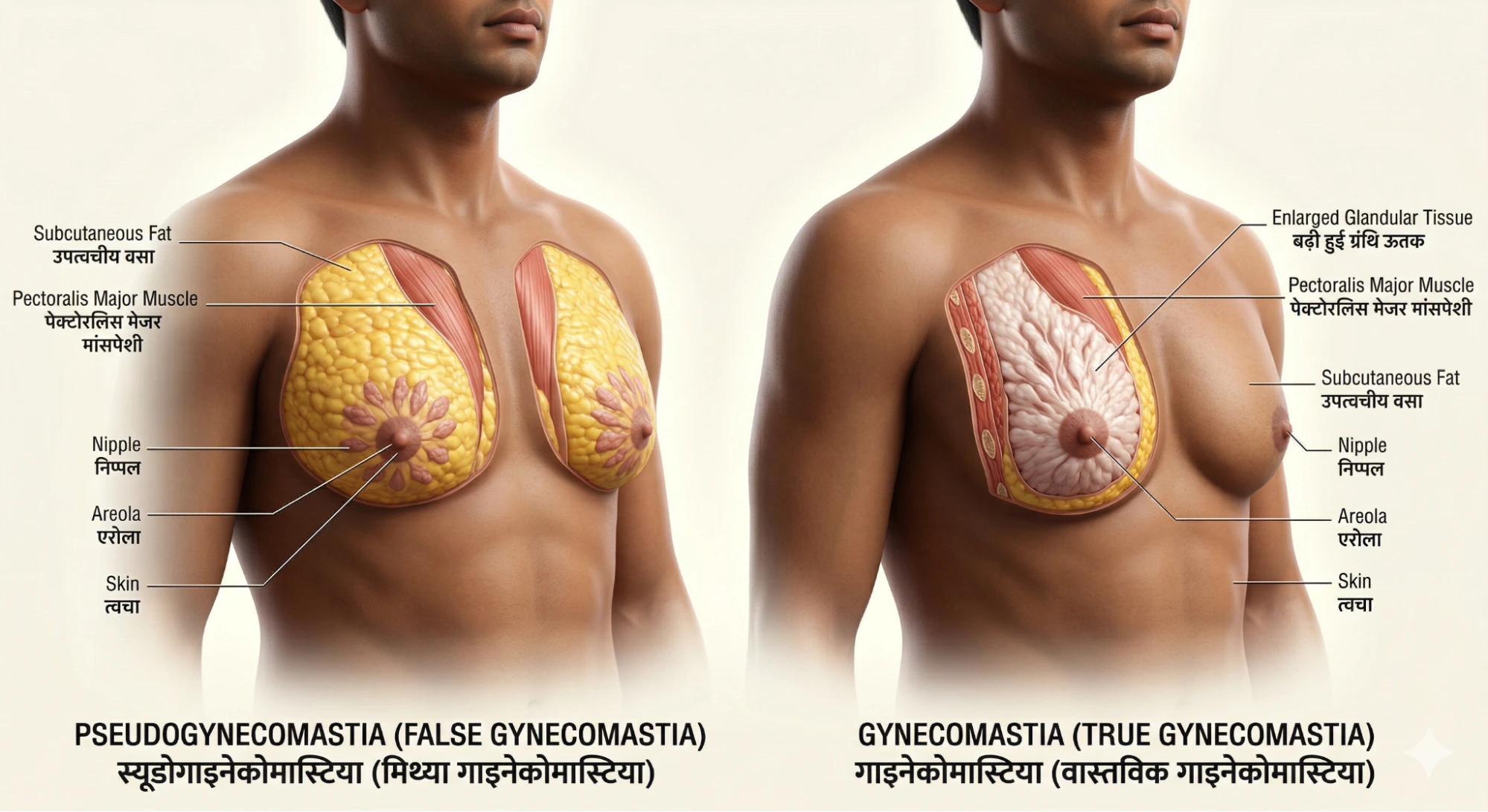
If I had to explain pseudogynecomastia vs gynecomastia in one line:
- One is fat you can burn
- The other is tissue you cannot train away
That’s the difference.
Related: Understanding Gynaecomastia: Causes, Treatment, and Permanent Male Chest Reduction
Now let’s talk about why this happens
Because this is where people get misled.
If it’s gynecomastia
This is not about laziness or poor fitness.
It’s usually hormonal.
Your body has a balance between testosterone and estrogen.
When that balance shifts, gland tissue grows.
Sometimes it happens:
- During puberty
- Later in life
- With certain medications
- Or just due to increased fat causing more aromatase activity (conversion of testosterone to estrogen)
So yes, fat can indirectly lead to gland growth too.
If it’s pseudogynecomastia
This one is straightforward.
You’ve gained fat. It’s sitting on your chest as it does on your abdomen.
No gland. No hormonal issue.
Here’s where most people get stuck
You assume:
“I’m overweight, so it must be fat.”
Not always.
A lot of men sitting in front of me have both.
Some fat. Some gland.
They lose weight. The chest improves a bit.
But that central fullness never goes.
That’s the gland.
Timing matters more than you think.
Let’s say it is gynecomastia.
Then the next question is: how long has it been there?
- If it’s been recent (a few months), the tissue is still active. In some cases, medicines can help.
- If it’s been over a year, it becomes dense and fibrous. At that point, tablets won’t do much.
That’s when surgery becomes the reliable option. So without waiting, you should consult a plastic surgeon who can diagnose your case and guide you perfectly.
So what are your options?
Depends on what you actually have.
If it’s fat (pseudogynecomastia)
You fix it the usual way:
- Fat loss
- Consistent training
- In some cases, CoolSculpting for shaping
If it’s gynecomastia
This is where expectations need to be realistic.
You can improve your physique, but that gland won’t disappear.
Surgical options are simple in concept:
- Remove the gland through a small incision near the nipple
- Combine with liposuction if there’s fat around it
Most patients need a combination. That’s how you get a flat, natural chest.
You might be wondering about “grades”
I don’t expect you to remember medical terms, but this is useful.
We classify gynecomastia using the Simon grading system.
Why?
Because not all chests are the same.
- Mild cases → simple correction
- Larger, sagging cases → more complex surgery
It helps us decide what approach will actually give you a good result.
One thing I want to say clearly
This is not just physical.
I see the same pattern:
- Avoiding tight clothes
- Pulling shirts forward
- Skipping swimming
- Always being aware of posture
You may not say it out loud, but it affects confidence.
And yes, correcting it does improve that. Significantly.
Before we end, a quick safety note
Not every chest change is gynecomastia.
If you notice:
- A hard, fixed lump
- Discharge from the nipple
- Skin dimpling
- Sudden unexplained changes
Don’t self-diagnose. Get it checked.
FAQs (what patients usually ask me)
No. Puffy nipples are usually due to gland tissue
If there’s no underlying firm tissue, it’s not gynecomastia. Some variation is normal.
Yes. It depends on fat, not age.
Puberty is the most common phase. It can also happen later in life.
No strong evidence. Most of this is speculation.
Yes. Excess testosterone can convert into estrogen, which can stimulate gland growth.
Final thought
Right now, you don’t need a solution.
You need clarity.
Once you know whether it’s fat or gland, the next step becomes obvious.
If you’re still unsure after checking, don’t keep guessing. One proper evaluation clears it up quickly.