
When Labiaplasty is medical, not cosmetic
Table of Contents
If you are reading this, there is a good chance you are uncomfortable, not curious.
You are not here because of appearance.
You are here because something does not feel right, physically.
Most women who search for labiplasty in Mumbai are doing so because of physical discomfort. You may have quietly searched at night, cleared your browser history, and wondered whether you were overreacting.
You are not.
This article is not meant to convince you to have surgery.
It is meant to help you understand when labiaplasty is a medical solution, and when it is not.
Why is this topic misunderstood?
Labiaplasty is often spoken about as a cosmetic procedure. That framing alone stops many women from seeking help.
The word “cosmetic” carries judgment. It suggests vanity. It suggests choice rather than need.
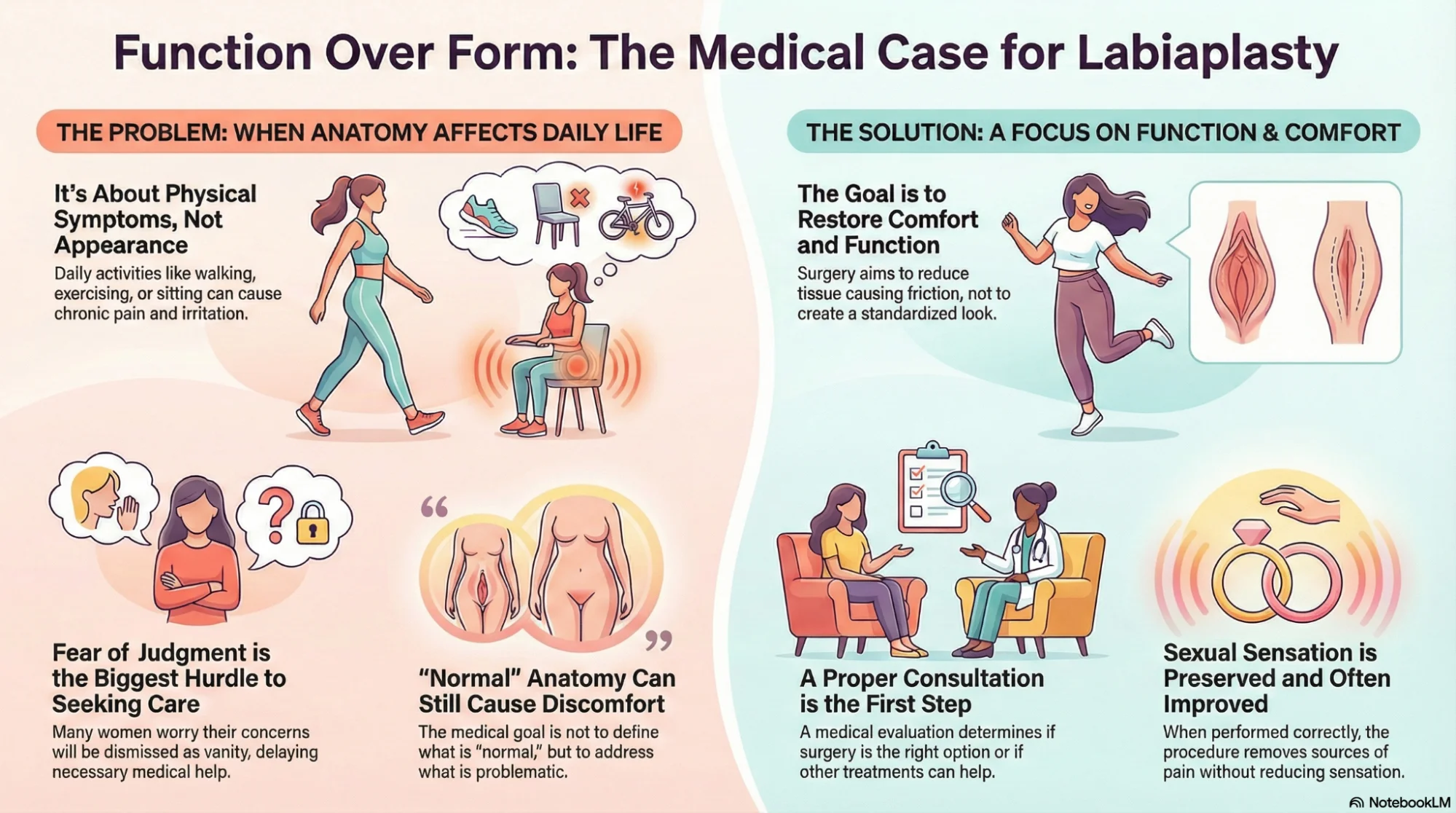
In reality, a large number of women who undergo labiaplasty do so because of persistent physical symptoms, not because of how they look.
The misunderstanding begins when all labiaplasties are placed in one category. Medicine does not work that way.
The difference between appearance and function
Female genital anatomy varies widely. Size, shape, symmetry, and visibility differ from woman to woman. Variation alone is not a problem.
A medical issue arises when anatomy interferes with normal function.
Function means:
- Walking without irritation
- Exercising without pain
- Sitting for long periods comfortably
- Maintaining hygiene without difficulty
- Intimacy without pulling or burning sensations
When these everyday actions are affected, the concern is no longer cosmetic.
Symptoms that make labiaplasty medical
In my practice, women who need labiaplasty for medical reasons usually describe specific, repeatable problems.
The most common ones are:
- Constant rubbing or chafing while walking
- Pain during cycling, running, or gym workouts
- Recurrent rashes or fungal infections despite good hygiene
- Skin getting caught or pinched in underwear
- Discomfort or pain during sexual activity
- Difficulty keeping the area dry, leading to irritation
These symptoms are not imagined. They are mechanical. Tissue rubs. Skin folds trap moisture. Movement causes friction.
Ignoring this does not make it resolve.
Why do many women tolerate this for years
Most women do not come in at the first sign of discomfort. They adapt instead.
They change clothing choices.
They stop specific exercises.
They avoid situations where symptoms worsen.
Some are told, directly or indirectly, that this is “normal.” Others assume it is something they must live with.
Chronic pain that is neither dramatic nor severe is easy to dismiss. That does not mean it should be.
“Is my anatomy normal?”
This is one of the most common questions I hear.
The honest answer is often yes.
But that is not the end of the discussion.
Normal anatomy does not guarantee comfort. Medicine is not only about defining what is normal. It is about addressing what is problematic for the individual.
If tissue size or shape repeatedly causes physical symptoms, intervention becomes reasonable.
When surgery is not the correct answer
It is essential to say this clearly.
Not every woman who experiences discomfort needs surgery.
Not every concern requires an operation.
Sometimes:
- Skin sensitivity is the primary issue
- Hygiene or dermatological treatment helps
- The anatomy is not the actual cause
A proper consultation includes ruling these out.
Surgery should never be the default response. It should be considered as an option when other measures fail or are clearly insufficient.
The fear that stops most women from asking
The most common fear is not pain.
It is not recovery.
It is not even scars.
It is the fear of being judged.
Women worry:
- That their concern will be dismissed
- That the conversation itself will feel awkward
- That they will be seen as vain or unreasonable
This fear delays care more than any medical risk.
A medical consultation should be neutral, respectful, and practical. Anything less is unacceptable.
Concern about sensation and sexual function
This fear is legitimate and deserves a clear answer.
When labiaplasty is performed correctly, preserving anatomical structures and nerve supply, sexual sensation is not reduced.
In fact, many women experience improvement because the source of pain, pulling, or irritation is removed.
Problems occur when:
- Excessive tissue is removed
- Anatomy is not respected
- The procedure is treated as purely cosmetic
This is why experience and technique matter more than promises.
What labiaplasty does and does not do
Medical labiaplasty aims to:
- Reduce the tissue that causes friction
- Improve comfort during movement and intimacy
- Preserve natural appearance and function
It does not aim to:
- Create a “standard” look
- Remove all visible tissue
- Change identity or sensation
If these expectations are not clear, dissatisfaction follows.
Safety and context in Mumbai
Labiaplasty in Mumbai is safe when performed:
- By a qualified plastic surgeon
- In a proper surgical facility
- With medical indication and planning
The risk is not location.
The risk is inappropriate surgery.
Choosing the right surgeon matters more than cost, convenience, or speed.
Recovery is often imagined as severe. In reality, it is usually manageable.
Most women experience:
- Swelling and tenderness initially
- Discomfort rather than intense pain
- Return to desk work in about a week
- Gradual healing over several weeks
Physical intimacy and strenuous exercise are avoided temporarily. This is part of healing, not a complication.
Recovery varies. Clear instructions and realistic expectations make a significant difference.
Privacy is not optional.
Any surgery involving intimate anatomy requires strict confidentiality and respectful handling.
Privacy is not a courtesy.
It is a standard.
If a patient does not feel safe or respected, the environment is wrong.
A final clarification
Wanting relief from physical discomfort does not make you vain.
Seeking information does not commit you to surgery.
Asking questions is not a weakness. It is self-care.
Labiaplasty is medical when it treats symptoms that affect daily life. Nothing more. Nothing less.
Many women who search for labiplasty in Mumbai are simply trying to understand whether what they are experiencing has a medical explanation and a medical solution.
That question deserves a calm, honest answer
My approach as a surgeon
My responsibility is to help you understand:
- Whether surgery is appropriate
- What it can realistically achieve
- What risks exist
- What alternatives may help
Sometimes surgery is the right solution.
Sometimes it is not.
Both answers are acceptable.
The goal is not surgery.
The goal is comfort, function, and informed choice.